


About this writing project:
The challenge: Hospital chaplains are everywhere and nowhere at once — essential to patient care but nearly invisible in how hospitals talk about themselves. I wanted to show what this work actually looks like when no one’s watching.
My approach: I followed the Rev. John Carlson for an entire shift, pager and all. Cardiac arrests, traffic accidents, families learning someone they love is dying — he moved between all of it without breaking stride. Instead of writing about chaplaincy in the abstract, I focused on the physical reality: the walking shoes, the endless loops through corridors, managing multiple families’ grief at the same time, meeting people wherever they are spiritually without pushing any particular framework.
The impact: The piece made visible work that hospitals depend on but rarely discuss. It showed spiritual care as what it actually is: skilled emotional triage, occasional detective work (tracking down patient identities), and the ability to be present across multiple crises at once. Readers got language for a role they may have encountered but never fully understood.
Published in the Orlando Sentinel on April 8, 2000
As much as any other tool of his trade, the Rev. John Carlson, a hospital chaplain, relies on good walking shoes.
He pairs black sneakers with his suit during rounds at Orlando Regional Medical Center, where every workday is a long, continuous loop through the halls.
A pager clipped to Carlson’s belt is his navigator, alerting him to whom he must see next: an incoming trauma patient, a cardiac arrest victim, arriving family members.
“Most people have the idea that we as chaplains come in, say a prayer, say ‘God bless you and God loves you,’” said Carlson, 57.
But his work is a mix of ministering, juggling and sleuthing.
He comforts the sick and dying and their loved ones — usually several sets of them at once — all over the hospital. He tracks down patients’ identities, using wallets, scraps of paper in pockets, a reverse phone directory and, once, even a prescription shoe insole.
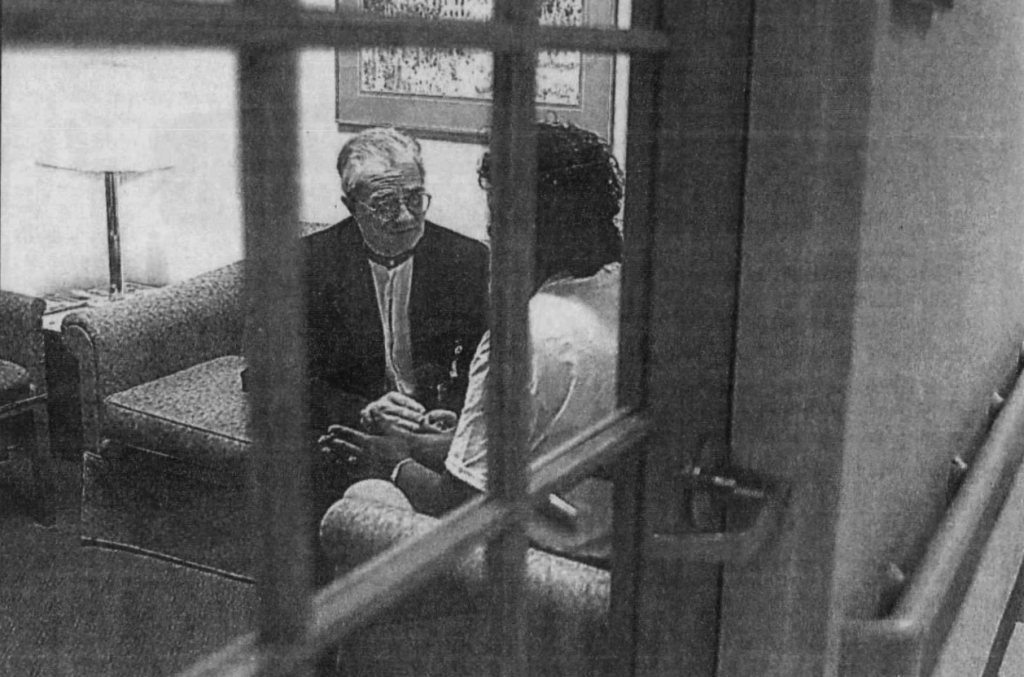
He considers himself a “bridge” that keeps people from drowning in grief.
Carlson, a Pentecostal pastor for a small church in addition to being one of the hospital’s full-time chaplains, doesn’t push religion on anyone.
“We speak of faith, but we speak of their faith, wherever they are spiritually,” he said.
The hospital has 10 full-time chaplains and another 10 that work part time. They represent several Protestant denominations. Chaplains can call in rabbis, priests or ministers for patients who request them.
On a recent day, just as he returned from lunch at TropiGrill, Carlson was paged: A longtime stomach-cancer patient had died. Carlson hurried upstairs to meet the man’s wife, who was sitting in the Consultation Room, dabbing her eyes with a tissue.
Carlson sat with her for about 15 minutes, holding her hands.
“There will be times that you will be by yourself,” Carlson murmured in a low, gravelly voice. “The loneliness will be overpowering. But your strength and your faith will get you through.”
That day, Carlson was also dealing with an unconscious traffic-accident victim from out of state; a man whose wife was quickly dying; and a 66-year-old woman who fell on an inch-thick pole that pierced her neck. Despite the frenzy, Carlson remained calm as he walked his continuous loop. He chatted with doctors and janitors, carrying on the conversation until he reached the end of the corridor.
“Did you check her driver’s license?” Carlson joked to a patient wheeled by a nurse into an elevator. Soon, his pager went off again. A code 90: cardiac or respiratory arrest. It was the dying woman he saw earlier.
Carlson found the woman’s husband and led him into the hallway. He put his arm around the man’s shoulders. “She’s having a hard time,” he said. “I think she’s declining.”
The status of the woman with the neck injury was still unclear. Her daughter had arrived and she was downstairs, sobbing in an emergency medical technician’s arms. Carlson took her aside.
“Thank you for being with her,” she said. “That’s all I pray for.”
“She’s in good hands with all the doctors,” Carlson said. “And she’s in good hands with God, too.”
Carlson describes his calling by invoking Psalm 23:4: Even though I walk through the valley of the shadow of death, I will fear no evil, for you are with me; your rod and your staff, they comfort me.
“We find people in the middle of that valley and we walk alongside them,” he said. “You have a present sense of being in God’s work. It’s a really powerful feeling.”


 Tiffini Theisen
Leave a comment