

About this writing and research project:
The challenge: Willoughby’s Open Hearth existed in Orlando’s collective memory as a stylish, indulgent restaurant from the 1970s, but the story had flattened into nostalgia. What was missing was context: how ambition, visibility, and risk intersected during a volatile period in the city’s growth — and how easily a place that once mattered could vanish without narrative closure.
My approach: In this project, I identified Willoughby’s as more than a defunct restaurant and treated it as a lens into Orlando’s cultural and economic transition in the 1970s. I synthesized archival reporting, price data, crime records, and personal recollections to trace a full arc — from aspirational glamour to vulnerability, violence, and eventual erasure.
The impact: The piece reframed a familiar local landmark as part of a broader civic pattern: how success, visibility and rapid growth can expose institutions and individuals to risk, and how cities quietly discard their own history. It invited readers to reconsider not just what Orlando used to be, but how — and why — certain stories fade unless they are deliberately preserved.
Originally published on the Orlando Sentinel on March 16, 2022
Willoughby’s Open Hearth Restaurant touted itself as a swank destination in Orlando in the 1970s.
The Olde English style eatery opened on East Colonial Drive in 1971, two years before the Orlando Fashion Square mall arrived next door. Its facade mimicked the half-timbered construction style of medieval European towns.
Willoughby’s tempted diners with advertisements promising plump chicken, thick slabs of steak, lobster tail, and “king-sized” cocktails.
Longtime Orlando residents recall a Kahlúa chocolate dessert being a favorite.
You could add an Irish coffee with whipped cream for $1.
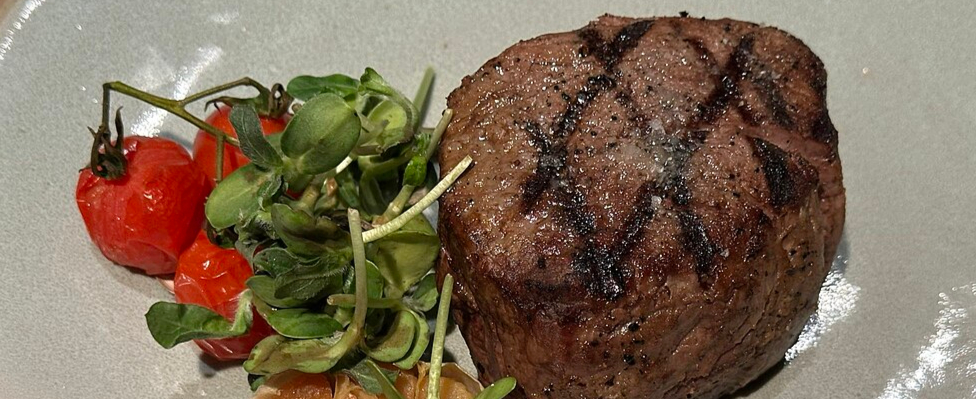
A filet mignon skewers dinner — with cherry tomatoes, mushroom caps, peppers and onions — would set you back $3.95 in 1972.
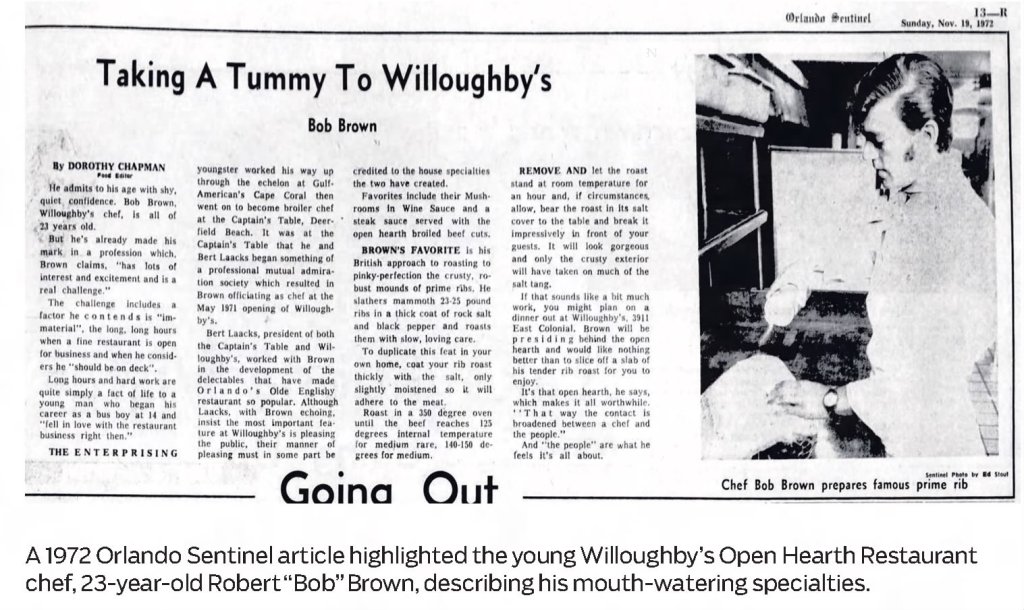
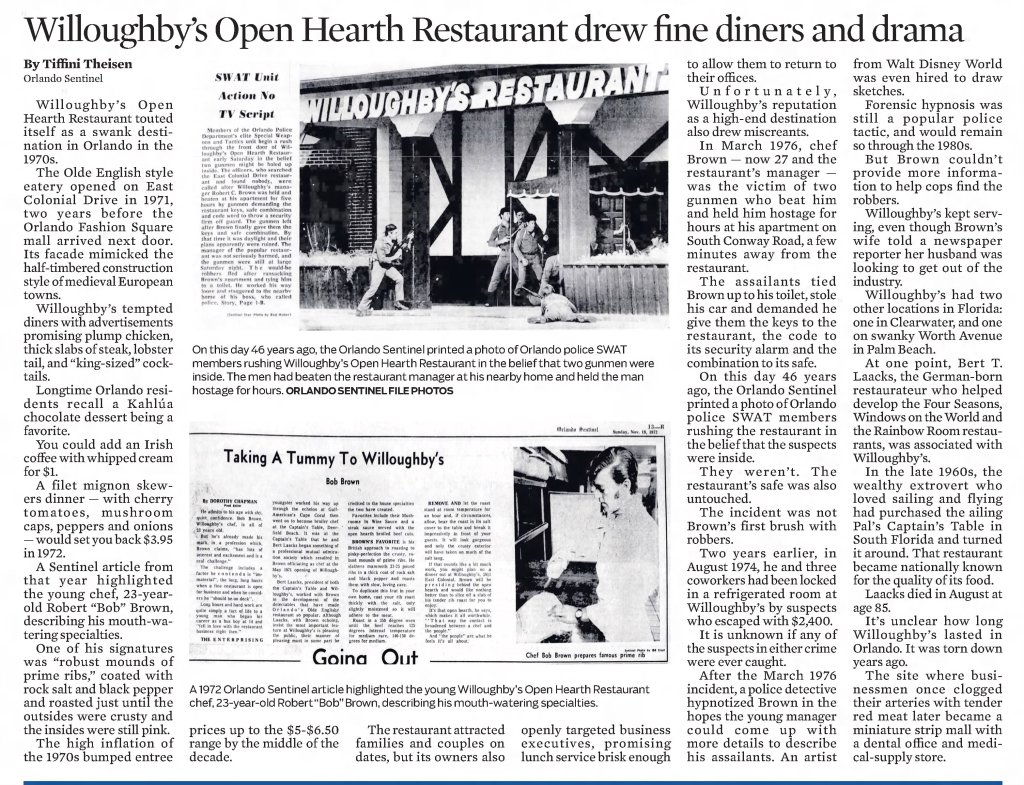
A Sentinel article from that year highlighted the young chef, 23-year-old Robert “Bob” Brown, describing his mouth-watering specialties.
One of his signatures was “robust mounds of prime ribs,” coated with rock salt and black pepper and roasted just until the outsides were crusty and the insides were still pink.
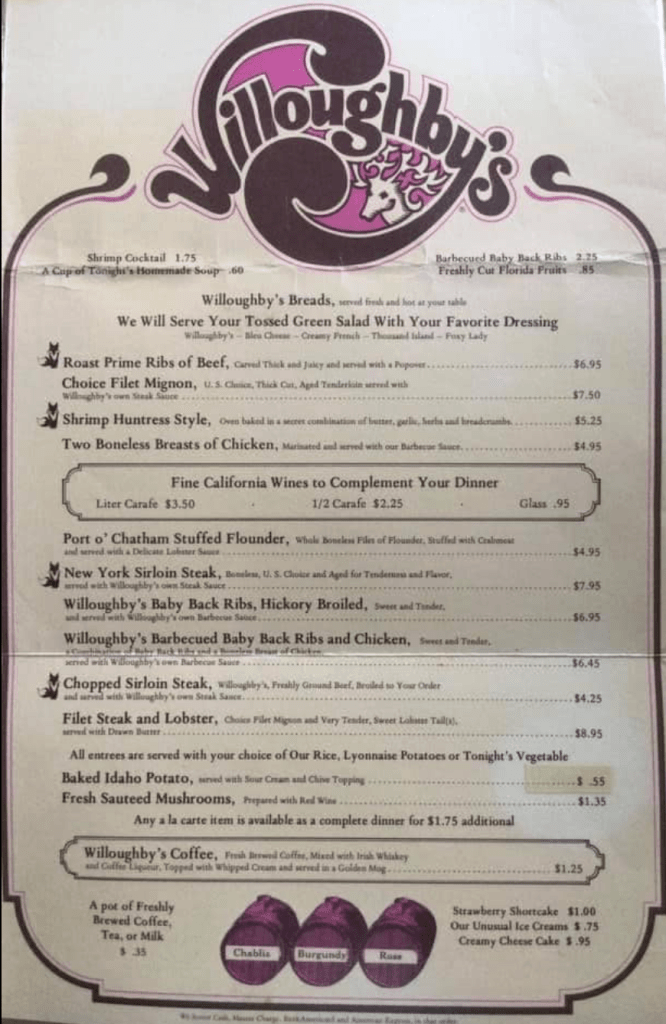
The high inflation of the 1970s bumped entree prices up to the $5-$6.50 range by the middle of the decade.
The restaurant attracted families and couples on dates, but its owners also openly targeted business executives, promising lunch service brisk enough to allow them to return to their offices.
Unfortunately, Willoughby’s reputation as a high-end destination also drew miscreants.
In March 1976, chef Brown — now 27 and the restaurant’s manager — was the victim of two gunmen who beat him and held him hostage for hours at his apartment on South Conway Road, a few minutes away from the restaurant.
The assailants tied Brown up to his toilet, stole his car and demanded he give them the keys to the restaurant, the code to its security alarm and the combination to its safe.
On this day 46 years ago, the Orlando Sentinel printed a photo of Orlando police SWAT members rushing the restaurant in the belief that the suspects were inside.
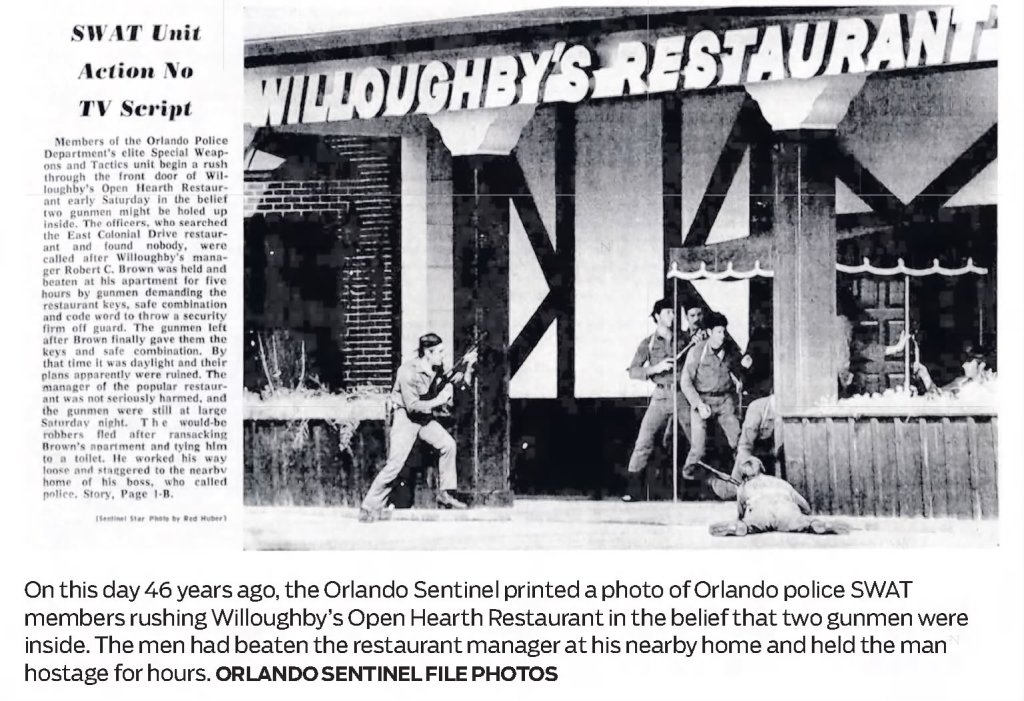
They weren’t. The restaurant’s safe was also untouched.
The incident was not Brown’s first brush with robbers.
Two years earlier, in August 1974, he and three coworkers had been locked in a refrigerated room at Willoughby’s by suspects who escaped with $2,400.
It is unknown if any of the suspects in either crime were ever caught.
After the March 1976 incident, a police detective hypnotized Brown in the hopes the young manager could come up with more details to describe his assailants. An artist from Walt Disney World was even hired to draw sketches.
Forensic hypnosis was still a popular police tactic, and would remain so through the 1980s.
But Brown couldn’t provide more information to help cops find the robbers.
Willoughby’s kept serving, even though Brown’s wife told a newspaper reporter her husband was looking to get out of the industry.
Willoughby’s had two other locations in Florida: one in Clearwater, and one on swanky Worth Avenue in Palm Beach.
At one point, Bert T. Laacks, the German-born restaurateur who helped develop the Four Seasons, Windows on the World and the Rainbow Room restaurants, was associated with Willoughby’s.
In the late 1960s, the wealthy extrovert who loved sailing and flying had purchased the ailing Pal’s Captain’s Table in South Florida and turned it around. That restaurant became nationally known for the quality of its food.
Laacks died in August 2021 at age 85.
It’s unclear how long Willoughby’s lasted in Orlando. It was torn down years ago.
The site where businessmen once clogged their arteries with tender red meat later became a miniature strip mall with a dental office and medical-supply store.
Read this article on OrlandoSentinel.com

 Tiffini Theisen
Leave a comment