


About this research and writing project:
The challenge: Men seek mental health help at less than half the rate women do, but public health messaging around this issue tends to either shame men for not opening up or oversimplify the cultural conditioning that teaches them emotional suppression from childhood. The gap between recognizing distress and seeking help often manifests as anger, substance abuse, or physical symptoms rather than acknowledged psychological struggle, making the problem harder to identify and address.
My approach: I interviewed clinical psychologist Dr. Jonathan Mitchell at Orlando Health Bayfront Hospital to explore why men avoid mental health care and what actually helps them move toward support. Rather than opening with statistics, I created composite portraits (Luis jogging at sunrise as anxiety management, David hiding exhaustion behind “I’m fine,” Joe’s retirement loneliness turning to drinking) that illustrate how mental health struggles show up in daily life. The piece required translating psychological concepts into accessible language, connecting childhood messaging (“man up,” “don’t cry”) to adult behavior patterns, and offering practical pathways (exercise, social connection, small disruptions to negative patterns) without prescribing cookie-cutter solutions or reinforcing the very shame that keeps men silent.
The impact: Published in St. Pete Life Magazine as part of a healthcare education partnership, the article gave readers tools to recognize mental health distress in themselves or men they care about, reframed help-seeking as strength rather than weakness, and offered concrete starting points (one deep conversation, a weekly game night, buying nutritious food) that feel achievable rather than overwhelming.
Published in St. Pete Life Magazine’s May/June 2025 “Best Life” health and wellness issue
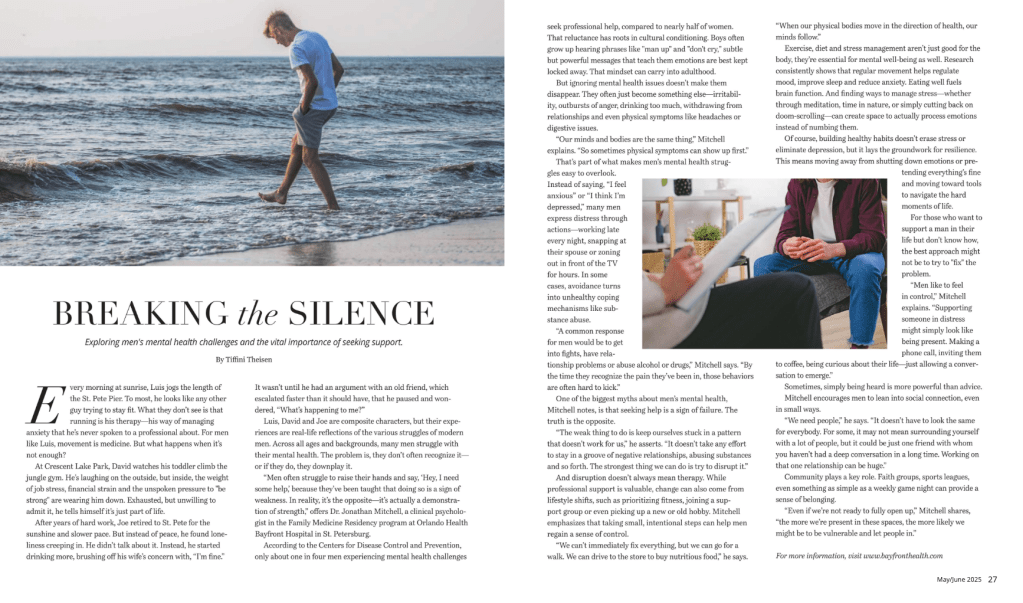
Every morning at sunrise, Luis jogs the length of the St. Pete Pier. To most, he looks like any other guy trying to stay fit. What they don’t see is that running is his therapy—his way of managing anxiety that he’s never spoken to a professional about. For men like Luis, movement is medicine. But what happens when it’s not enough?
At Crescent Lake Park, David watches his toddler climb the jungle gym. He’s laughing on the outside, but inside, the weight of job stress, financial strain and the unspoken pressure to “be strong” are wearing him down. Exhausted, but unwilling to admit it, he tells himself it’s just part of life.
After years of hard work, Joe retired to St. Pete for the sunshine and slower pace. But instead of peace, he found loneliness creeping in. He didn’t talk about it. Instead, he started drinking more, brushing off his wife’s concern with, “I’m fine.” It wasn’t until he had an argument with an old friend, which escalated faster than it should have, that he paused and wondered, “What’s happening to me?”
Luis, David and Joe are composite characters, but their experiences are real-life reflections of the various struggles of modern men. Across all ages and backgrounds, many men struggle with their mental health. The problem is, they don’t often recognize it—or if they do, they downplay it.
“Men often struggle to raise their hands and say, ‘Hey, I need some help,’ because they’ve been taught that doing so is a sign of weakness. In reality, it’s the opposite—it’s actually a demonstration of strength,” offers Dr. Jonathan Mitchell, a clinical psychologist in the Family Medicine Residency program at Orlando Health Bayfront Hospital in St. Petersburg.
According to the Centers for Disease Control and Prevention, only about one in four men experiencing mental health challenges seek professional help, compared to nearly half of women. That reluctance has roots in cultural conditioning. Boys often grow up hearing phrases like “man up” and “don’t cry,” subtle but powerful messages that teach them emotions are best kept locked away. That mindset can carry into adulthood.
But ignoring mental health issues doesn’t make them disappear. They often just become something else—irritability, outbursts of anger, drinking too much, withdrawing from relationships and even physical symptoms like headaches or digestive issues.
“Our minds and bodies are the same thing,” Mitchell explains. “So sometimes physical symptoms can show up first.”
That’s part of what makes men’s mental health struggles easy to overlook. Instead of saying, “I feel anxious” or “I think I’m depressed,” many men express distress through actions—working late every night, snapping at their spouse or zoning out in front of the TV for hours. In some cases, avoidance turns into unhealthy coping mechanisms like substance abuse.
“A common response for men would be to get into fights, have relationship problems or abuse alcohol or drugs,” Mitchell says. “By the time they recognize the pain they’ve been in, those behaviors are often hard to kick.”

One of the biggest myths about men’s mental health, Mitchell notes, is that seeking help is a sign of failure. The truth is the opposite.
“The weak thing to do is keep ourselves stuck in a pattern that doesn’t work for us,” he asserts. “It doesn’t take any effort to stay in a groove of negative relationships, abusing substances and so forth. The strongest thing we can do is try to disrupt it.”
And disruption doesn’t always mean therapy. While professional support is valuable, change can also come from lifestyle shifts, such as prioritizing fitness, joining a support group or even picking up a new or old hobby. Mitchell emphasizes that taking small, intentional steps can help men regain a sense of control.
“We can’t immediately fix everything, but we can go for a walk. We can drive to the store to buy nutritious food,” he says. “When our physical bodies move in the direction of health, our minds follow.”
Exercise, diet and stress management aren’t just good for the body, they’re essential for mental well-being as well. Research consistently shows that regular movement helps regulate mood, improve sleep and reduce anxiety. Eating well fuels brain function. And finding ways to manage stress—whether through meditation, time in nature, or simply cutting back on doom-scrolling—can create space to actually process emotions instead of numbing them.
Of course, building healthy habits doesn’t erase stress or eliminate depression, but it lays the groundwork for resilience. This means moving away from shutting down emotions or pretending everything’s fine and moving toward tools to navigate the hard moments of life.
For those who want to support a man in their life but don’t know how, the best approach might not be to try to “fix” the problem.
“Men like to feel in control,” Mitchell explains. “Supporting someone in distress might simply look like being present. Making a phone call, inviting them to coffee, being curious about their life—just allowing a conversation to emerge.”
Sometimes, simply being heard is more powerful than advice.
Mitchell encourages men to lean into social connection, even in small ways.
“We need people,” he says. “It doesn’t have to look the same for everybody. For some, it may not mean surrounding yourself with a lot of people, but it could be just one friend with whom you haven’t had a deep conversation in a long time. Working on that one relationship can be huge.”
Community plays a key role. Faith groups, sports leagues, even something as simple as a weekly game night can provide a sense of belonging.
“Even if we’re not ready to fully open up,” Mitchell shares, “the more we’re present in these spaces, the more likely we might be to be vulnerable and let people in.”
Read this article at StPeteLifeMag.com

 Tiffini Theisen
Leave a comment